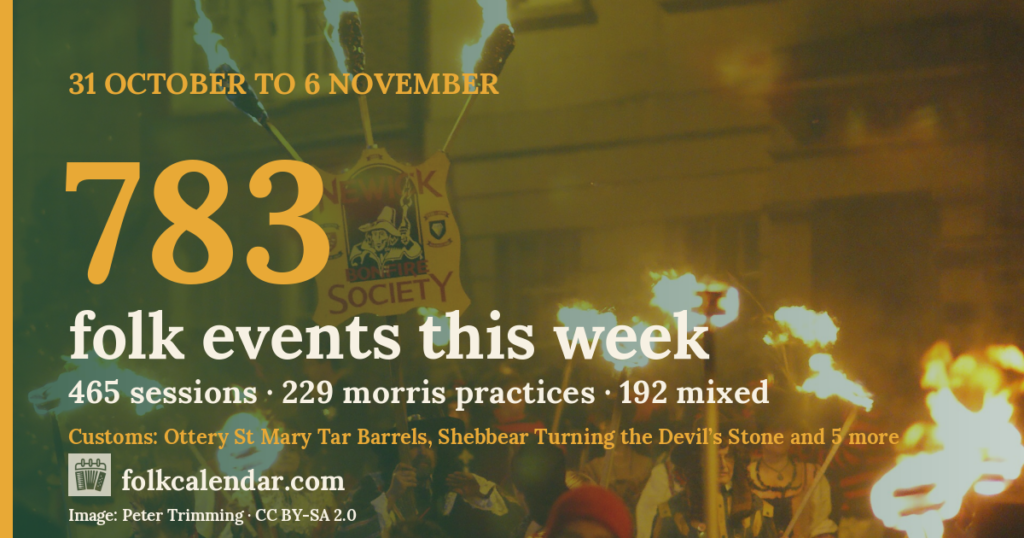
More going on than last week: 465 sessions, 229 morris practices, 49 folk club nights, 33 dances and 7 customs on the calendar, up from 705.
Sessions this week
Something for everyone:
- 192 mixed sessions, among them 49 Traditional sessions, 35 listeners welcome sessions, 31 English sessions and 30 Scottish sessions.
- 183 tune sessions: 126 Irish, 54 Scottish, 21 Traditional and 21 listeners welcome ones.
- 85 song sessions, with 35 singaround sessions, 23 Traditional sessions, 15 listeners welcome sessions and 10 Shanties sessions among them.
- Plus 5 other sessions.
Morris practices this week
By type, that’s:
- 114 Cotswold morris practices.
- 64 Border morris practices.
- 46 North-West morris practices.
- 9 Longsword morris practices.
Folk club nights this week
Dances this week
Broken down, that’s:
Customs this week
Worth the trip:
- Ottery St Mary Tar Barrels, Ottery St Mary, on Thursday.
- Shebbear Turning the Devil’s Stone, Shebbear, on Thursday.
- Hop tu Naa Festival at Cregneash, Cregneash, on Saturday.
- Samhain Fire at Athboy, Athboy, on Saturday.
- Samhuinn Fire Festival, Edinburgh, on Saturday.
- Derry Halloween Carnival Parade, Derry, on Saturday.
- Newick Bonfire, Newick, on Saturday.
Further ahead: Bridgwater Guy Fawkes Carnival (Saturday 7 November), Edenbridge Bonfire (Saturday 7 November) and East Hoathly and Halland Carnival (Saturday 7 November).
The busiest day is Thursday, with 163 events.
Worth knowing: Saturday is Hallowe'en and Thursday is Bonfire Night.
Folklore from the old calendars
Once upon a time, this week:
- Nutcrack Night, Saturday, Northern England: In the north of England Hallowe'en was called Nutcrack Night, from the nuts cracked, eaten and thrown on the fire.
- Burning the Nuts, Saturday, Scotland, Ireland and England: On Hallowe'en a pair of nuts was named for a lad and a lass and laid in the fire.
- Pulling the Kail Stocks, Saturday, Scotland: The first rite of a Scottish Hallowe'en was to go out hand in hand, eyes shut, into the kailyard and each pull the first cabbage stalk they touched.
- The Apple and the Looking-Glass, Saturday, Scotland: A girl who wanted to see her future husband went alone with a candle to a looking-glass on Hallowe'en and ate an apple in front of it, some said while combing her hair.
- Coel Coeth, Saturday, North Wales: On All Saints' Eve every family in North Wales lit a large bonfire, called Coel Coeth, in the most prominent spot near the house.
- Ale for Shony, Saturday, Isle of Lewis, Outer Hebrides: At Hallowtide the people of Lewis met at the church of St Mulvay, each family bringing malt that was brewed into ale.
- Lating the Witches, Saturday, Longridge Fell, Lancashire: On Hallowe'en a party led by an old woman went round the bigger houses near Longridge Fell asking for lating candles, one for each person in the household.
- Cyniver, Saturday, Wales: Among the Hallowe'en customs he gathered, Hone gave a Welsh game from Owen's Welsh Dictionary.
- The Blue Clue, Saturday, West of Scotland: One of the Hallowe'en spells Burns described among the country people of the west of Scotland had to be tried alone and in the dark.
- Sowing Hemp-seed, Saturday, Scotland and Ireland: On Hallowe'en a girl crept out unseen and sowed a handful of hemp-seed, dragging something behind her to harrow it in, and saying a rhyme over and over.
- Winnowing Three Wechts, Saturday, West of Scotland: To win three wechts of naething, a Scottish spell for Hallowe'en, the seeker went alone to the barn and opened both doors, taking them off their hinges if possible.
- Fathoming the Stack, Saturday, West of Scotland: Another Scottish Hallowe'en charm from Burns was to slip out unnoticed to a stack of barley, called a bear stack, and measure round it three times with outstretched arms.
- The Wet Sark Sleeve, Saturday, Scotland and Ireland: In the Scottish form of this Hallowe'en spell the seeker dipped the left shirt sleeve in a south-running burn where the lands of three lairds met.
- The Three Luggies, Saturday, Scotland: Three dishes, or luggies, were set on the hearth at Hallowe'en, one with clean water, one with foul water and one empty.
- Sowens for the Hallowe’en Supper, Saturday, Scotland: Sowens was a thin dish made by steeping oat husks and meal in water until it soured, and in many parts of Scotland it was the proper supper for Hallowe'en.
- The Logierait Faggots, Saturday, Logierait, Perthshire: The minister of Logierait in Perthshire described the chief ceremony of Hallowe'en, kept there on 31 October by the old style calendar.
- The Callander Stones, Saturday, Callander, Perthshire: At Callander a bonfire was lit in every village on All Saints' Eve.
- The Buchan Hallow Fire, Saturday, Buchan, Aberdeenshire: In Buchan a Hallow Eve fire was lit on rising ground, and in Moray the eve of 1 November had been kept as a thanksgiving for the safe gathering of the harvest.
- The Black Short-tailed Sow, Saturday, North Wales: The autumn fire lit in North Wales on the eve of 1 November came with a round of ceremonies, according to an account Hone quoted from Owen.
- The St Kilda Hallowe’en Cake, Saturday, St Kilda, Outer Hebrides: Martin's account of the Western Isles, quoted by Hone, recorded that the people of St Kilda baked a special cake on Hallowe'en.
- Oidhche Shamhna, Saturday, Ireland: On the eve of Samhain, according to General Vallancey, Irish country people went from house to house carrying sticks and clubs, collecting money, bread, butter, cheese and eggs for the feast and reciting verses.
- Lamb’s-wool on Holy Eve, Saturday, Ireland: A writer in the Gentleman's Magazine said that no merry-making on Holy Eve in Ireland was without lamb's-wool, made by bruising roasted apples into ale or sometimes milk; in better houses white wine had once been used instead.
- Born on Hallowe’en, Saturday, Scotland: It was popularly believed that a child born on Hallowe'en had strange gifts.
- The Leinster Hallowe’en Spell, Saturday, Leinster, Ireland: Chambers printed a story from a Leinster family of the eighteenth century.
- Fire and red low, Saturday: Dugdale noted in one of his almanacs of 1658 that on All Hallow Even the master of the family used anciently to carry a bunch of lighted straw about his corn.
- Cake Night at Ripon, Saturday, Ripon, Yorkshire: At Ripon on the eve of All Saints the good wives made a cake for everyone in the family, so the evening was generally called Cake Night.
- Saining the boats in Orkney, Saturday, Orkney: John Brand, describing Orkney at the end of the seventeenth century, found that sick cattle were sprinkled with a charmed water called forespoken water, and so were boats that had no luck at the fishing.
- The Gyar-Carlins, Saturday, Scotland: Robert Heron, travelling through Scotland in the 1790s, found the fairies thought of as little beings, sometimes kind and sometimes spiteful.
- Apple and candle on Halle e’en, Saturday, Northern England: On Halloween young people in the North ducked for apples or snapped at one fixed to the end of a hanging beam with a lighted candle on the other end.
- Hey-how for Hallowe’en, Saturday, Northern England: Hallowe'en was the night when all the witches could be seen, and a rhyme hailed it as such.
- The Whitbeck bull and the winter wind, Saturday, Whitbeck, Cumberland: At Whitbeck in Cumberland it was said that whichever way a bull faced as he lay on Hallowe'en, the wind would blow from that quarter for most of the winter.
- The parish clerk leads the doomed at Sedbergh, Saturday, Sedbergh, West Riding, Yorkshire: At Sedbergh it was believed that on All Saints' Eve the forms of all who would die that year paraded the churchyard, led by the parish clerk.
- The Queen’s Hallowe’en at Balmoral, Saturday, Balmoral, Aberdeenshire: At Balmoral the estate people kept Hallowe'en with a torchlight procession of up to two hundred torch-bearers, and the torches were then heaped into a bonfire in view of the castle.
- No wheat sown after Hallowmas Eve, Saturday, England: Wheat sowing was to be over by Hallowmas Eve.
- Hallowe’en fires in the White Cart at Paisley, Saturday, Paisley, Renfrewshire: On Hallowe'en the boys of Paisley built round hearths of clay walled with stones and sods out in the shallows of the river White Cart and lit bonfires on them.
- New hearth fire from Tlachtga, Saturday, Ireland: On the eve of the first of November every household in Ireland was said to put out its fire and fetch a portion of the Arch-druid's consecrated fire from Tlachtga in Meath to kindle the hearth anew.
- The Eastwood woman rebuked for a Hallowe’en charm, Saturday, Eastwood, Renfrewshire: A woman of Eastwood was brought before the kirk session for using charms at Hallowe'en.
- Hemp-seed round the church at midnight, Saturday, Wales: On All Hallows Eve in Wales a person would sow hemp-seed while walking round the church a little before midnight.
- Names of the dead at the church door, Saturday, Wales: On All Hallows Eve some in Wales listened at the great door of the church to hear the names of those who would die in the coming year.
- Cynddilig’s cock against the hooping-cough, Saturday, Llanrhystud, Cardiganshire: In the parish of Llanrhystud in Cardiganshire, from midday to midnight on the eve of the first of November, people were allowed to offer a cock to St Cynddilig as a guard against whooping-cough.
- The yarn ladder on Hallowe’en, Saturday, Wales: On Hallowe'en two Welsh girls made a little ladder of yarn without breaking it from the ball and threw it out of the window.
- Iolo ap Hugh’s fiddle on Hallowe’en, Saturday, Chirk, Denbighshire: A cave said to run from Morda to Chirk Castle drew in anyone who went near it, and on Hallowe'en the wandering fiddler Iolo ap Hugh went in with bread, cheese, candles and his fiddle and was never seen again.
- The death roll at Aberhafesp church, Saturday, Aberhafesp, Montgomeryshire: Two men sat in the porch of Aberhafesp church on All Hallows' Eve to learn whether anyone in the parish would die in the coming year, and at midnight one heard a voice inside call his sleeping companion's name.
- The Angelystor of Llangernyw, Saturday, Llangernyw, Denbighshire: At Llangernyw it was said that on All Hallows' Eve a spirit called the Angelystor announced from the altar the names of everyone who would die in the parish that year.
- Seven times round the church on All Hallows’ Eve, Saturday, Montgomeryshire: A Montgomeryshire servant girl walked seven times round the church on All Hallows' Eve to raise the spirit of the man she would marry, and came home asking her mistress why the master had been sent out to frighten her.
- Grass from under the holly on All Hallows’ Eve, Saturday, Wales: On All Hallows' Eve a Welsh girl walked backwards to a holly tree, pulled a handful of grass from under it and carried it to the light, where she would find hairs of her true love among the blades.
- All-Hallowtide revels at the Middle Temple, Sunday, Middle Temple, London: The young lawyers of the Middle Temple counted All-Hallowtide as the start of Christmas, and in the reign of Charles I they chose a Master of the Revels for the season.
- The All Saints’ triplets, Sunday: A correspondent signing himself Gwilym Sais sent Hone seven triplets for the first of November, the Welsh Calan Gaeaf, from William Owen Pughe's translations of the elegies of Llywarch Hen.
- Dole bread in Monmouthshire, Sunday, Monmouthshire: Britton wrote in his Cathedral Antiquities that in Monmouthshire the poorer people, Catholic and Protestant alike, went begging bread for the souls of the dead on All Saints' Day.
- Seed cake at Allhallows, Sunday, Warwickshire: Brand's servant, a Warwickshire man, told him that in that county a seed cake was had at Allhallows, marking the end of wheat sowing.
- Souling in Staffordshire, Sunday, Staffordshire: Tollett noted that on All Saints' Day the poor of Staffordshire went from parish to parish souling, begging and singing for soul cakes or anything else to make them merry.
- The Cheshire souling song, Sunday, Cheshire: On the eve of All Souls' Day parties of boys in Cheshire went souling from door to door, singing for apples, pears, plums, beer or money.
- The first three days of winter, Sunday, Kirkmichael, Banffshire: The minister of Kirkmichael in Banffshire reported a Gaelic weather saying about the first three days of winter, which began at Hallowtide.
- Ringing for all Christian souls, Sunday: Before the Reformation the church bells were rung all night at Allhallowtide for all Christian souls.
- Pork, souse and sprats at All Saints, Sunday, England: All Saints was the season for pork and souse, the pickled parts of the pig, and for laying in sprats and spurlings.
- Slaughter time at Hallowtide, Sunday, England: Hallowtide began the season for killing stock, and with it the husbandman's feasting.
- Hallow-fair at Fordyce, Sunday, Fordyce, Banffshire: Fordyce's yearly market was called Hallow-fair, and its charter of 1592 set it at All Hallows, to run for eight days.
- The rough first day of winter, Sunday, Wales: An old Welsh triplet held that Calangauaf, the first day of winter, brought hard weather quite unlike the first day of summer, but that only God could foretell what was to come.
- Soul-mass cakes, Monday, Lancashire and Herefordshire: On All Souls' Day in Lancashire and Herefordshire the well-off used to hand out oaten cakes, called soul-mass cakes, to the poor.
- Old Hob, Monday, Cheshire: A correspondent told Hone of a Cheshire frolic called Old Hob, in which a man carried a dead horse's head covered with a sheet to frighten people.
- The Shropshire soul-cake heap, Monday, Shropshire: Aubrey wrote that in his time, in Shropshire and elsewhere, a high heap of soul cakes was set on the board on All Souls' Day, lying one upon another like the shewbread in the pictures of old Bibles.
- Tindles at Findern, Monday, Findern, Derbyshire: At Findern in Derbyshire the boys and girls went every year on the evening of All Souls' Day to the common and lit a number of small fires among the furze, which they called Tindles.
- The Gill-Bushes dole on All Souls’ Day, Monday, Torpenhow, Cumberland: Every year on 2 November the rent of a field called Gill-Bushes was given out to the poor of Blennerhasset in Torpenhow church.
- Stot Tuesday at Settle, Tuesday, Settle, Yorkshire: On the first Tuesday after 27 October, Settle held a fair for selling stots, or bullocks, known as Stot or Great Tuesday.
- Aubrey’s unlucky birthday, Tuesday, England: John Aubrey believed that 3 November, his own birthday, was an unlucky day for him.
- St Rumbold’s image at Boxley, Tuesday, Boxley Abbey, Kent: Boxley Abbey kept a small hollow image of St Rumbold, the infant saint, which a child could lift but which sometimes proved too heavy for strong men to move.
- Queen Mary’s daughter at Kirkby Stephen, Wednesday, Kirkby Stephen, Westmorland: On the eve of the Fifth of November two or three dozen lads went round Kirkby Stephen roaring a rhyme to collect money for gunpowder and tar barrels.
- Guy Fawkes’ Day, Thursday: An Act of 1606 made the anniversary of the Gunpowder Plot a holiday, and by Chambers's day it was one of the most joyous days of the year for English boys.
- The Purton bonfire, Thursday, Purton, Wiltshire: For weeks before the Fifth the boys of Purton went to every house begging faggots, with a rhyme threatening to take two if they were refused one, and one hard farmer lost a new pump to the fire.
- The Islip bonfire rhyme, Thursday, Islip, Oxfordshire: The boys who carried the guy round on the Fifth had many local versions of the rhyme.
- Beating the sticks round the Marlborough bonfire, Thursday, Marlborough, Wiltshire: At the Marlborough bonfires the country people walked round the fire in a ring, holding thick club-sticks over their shoulders.
- Remember the Bonfire at Walthamstow, Thursday, Walthamstow, Essex: On Bonfire Night the bonfire boys of Walthamstow chanted the Gunpowder Plot rhyme, asking for a stick and a stake for King George's sake, and then gave three halloos.
- The butchers’ bonfire in Clare Market, Thursday, Clare Market, London: On the fifth of November the butchers of Clare Market built their own bonfire in the open market by Bear Yard and thrashed each other round it with the sinews of slaughtered bulls.
- St Leonard’s half-holiday, Friday, Worcester: St Leonard, a Frankish hermit, was especially invoked for prisoners and was the patron of many large English churches.
Find the books: Chambers's Book of Days at Amazon, Bookshop.org or AbeBooks; Hone's Every-Day Book at Amazon, Bookshop.org or AbeBooks; Hone's Year Book at Amazon, Bookshop.org or AbeBooks; Brand's Popular Antiquities at Amazon, Bookshop.org or AbeBooks; Brockett's Glossary of North Country Words at Amazon, Bookshop.org or AbeBooks; The Denham Tracts at Amazon, Bookshop.org or AbeBooks; Henderson's Folk-Lore of the Northern Counties at Amazon, Bookshop.org or AbeBooks; Hazlitt's Faiths and Folklore at Amazon, Bookshop.org or AbeBooks; Tusser's Five Hundred Points of Good Husbandry at Amazon, Bookshop.org or AbeBooks; Sinclair's Statistical Account of Scotland at Amazon, Bookshop.org or AbeBooks; Roberts's Cambrian Popular Antiquities at Amazon, Bookshop.org or AbeBooks; Trevelyan's Folk-Lore of Wales at Amazon, Bookshop.org or AbeBooks; Owen's Welsh Folk-Lore at Amazon, Bookshop.org or AbeBooks; Hutchinson's History of Cumberland at Amazon, Bookshop.org or AbeBooks; Aubrey's Miscellanies at Amazon, Bookshop.org or AbeBooks; Dyer's British Popular Customs at Amazon, Bookshop.org or AbeBooks; Forster's Perennial Calendar at Amazon, Bookshop.org or AbeBooks. (Affiliate links: we may earn a small commission.)
Run a session, morris practice, folk club night, dance or custom?
Sign in and check your listing. It takes an email address, no password. Spotted your session, morris practice, folk club night, dance or custom without an owner? Claim it from its page and it’s yours to keep up to date. Missing from the calendar? Add it. It takes about two minutes.
Get out there, and have a good week.